
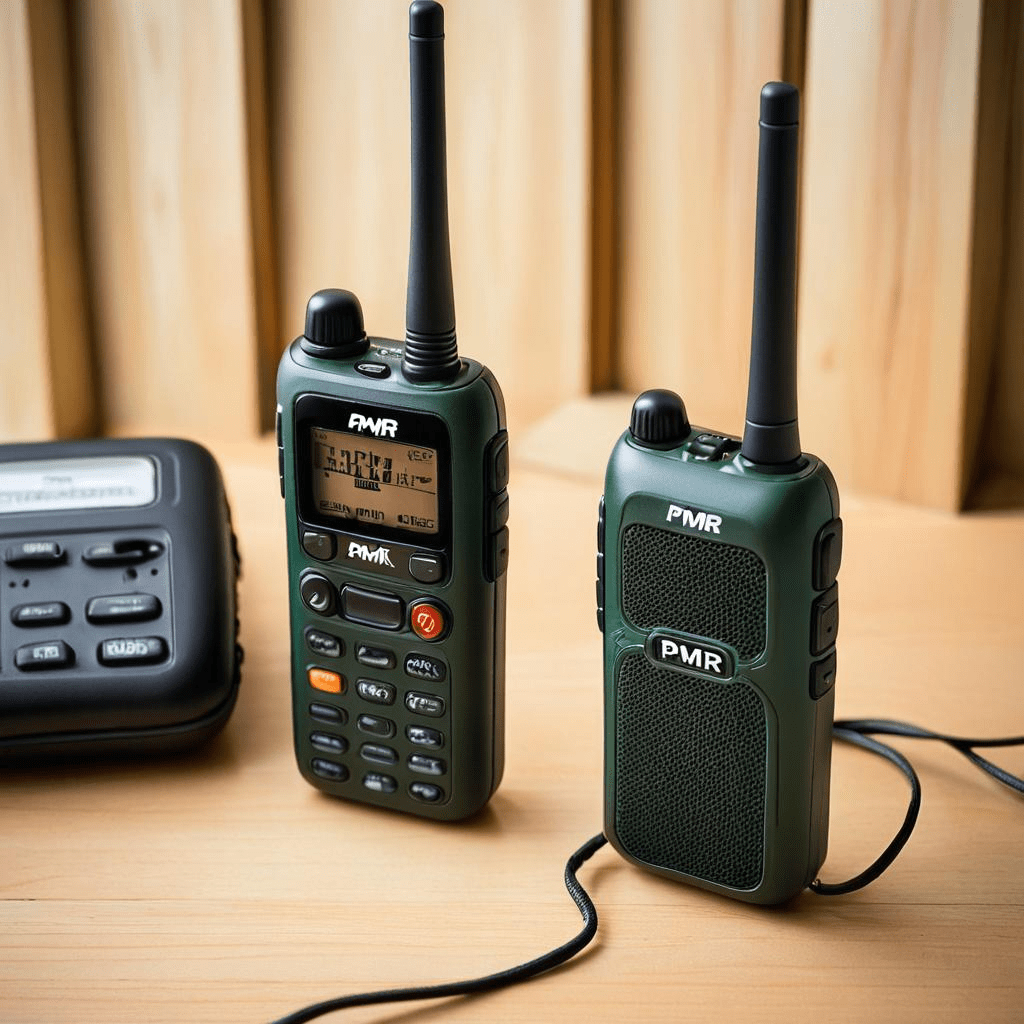
PMR 446 – What It Is and What It's For
PMR, or Personal Mobile Radios, are licence-free radios that require no licensing or fee payment from the user, making them accessible to everyone, including children, and they are used mainly for local line-of-sight communications.
There are, however, situations in which, under the right conditions, you can achieve communications over several kilometres through obstacles, which makes them a useful tool in the event of a local disaster.
These radios are nonetheless limited by law in certain technical respects: they must not have a removable antenna nor transmit at a power above 0.5 watts.
The name PMR 446 comes from the English abbreviation for "Personal Mobile Radio", with 446 indicating the UHF frequency band on which the radios operate.
The band around 446 MHz is divided into 16 sections with 12.5 kHz spacing in analogue mode (starting at 446.00625 MHz and ending at 446.19375) and 32 sections in digital mode with 6.25 kHz spacing (starting at 446.003125 MHz and ending at 446.196875 MHz).
These sections are called channels or memories.
Within these channels there are also subchannels that allow the operator to communicate without hearing the others, thereby reducing the noise from parallel conversations. This does not, however, mean that the communications are private, because anyone on the main channel still hears all conversations, regardless of which subchannel they may originate from.
Since this type of radio communication depends on line of sight, choosing a high vantage point gives users the best range. Atmospheric conditions also have a major influence on the propagation of radio signals depending on the ionisation of the atmosphere, so it is normal to get unusual results on days with electrical storms.
Analogue Frequencies
(12.5 kHz spacing)
Channel 01 – 446.00625 MHz
Channel 02 – 446.01875 MHz
Channel 03 – 446.03125 MHz
Channel 04 – 446.04375 MHz
Channel 05 – 446.05625 MHz
Channel 06 – 446.06875 MHz
Channel 07 – 446.08125 MHz
Channel 08 – 446.09375 MHz
Channel 09 – 446,10625 MHz
Channel 10 – 446,11875 MHz
Channel 11 – 446,13125 MHz
Channel 12 – 446,14375 MHz
Channel 13 – 446,15625 MHz
Channel 14 – 446,16875 MHz
Channel 15 – 446,18125 MHz
Channel 16 – 446,19375 MHz
Digital Frequencies
(6.25 kHz spacing)
Channel 01 – 446.003125 MHz
Channel 02 – 446.009375 MHz
Channel 03 – 446.015625 MHz
Channel 04 – 446.021875 MHz
Channel 05 – 446.028125 MHz
Channel 06 – 446.034375 MHz
Channel 07 – 446.040625 MHz
Channel 08 – 446.046875 MHz
Channel 09 – 446.053125 MHz
Channel 10 – 446.059375 MHz
Channel 11 – 446.065625 MHz
Channel 12 – 446.071875 MHz
Channel 13 – 446.078125 MHz
Channel 14 – 446.084375 MHz
Channel 15 – 446.090625 MHz
Channel 16 – 446.096875 MHz
Channel 17 – 446.103125 MHz
Channel 18 – 446.109375 MHz
Channel 19 – 446.115625 MHz
Channel 20 – 446.121875 MHz
Channel 21 – 446.128125 MHz
Channel 22 – 446.134375 MHz
Channel 23 – 446.140625 MHz
Channel 24 – 446.146875 MHz
Channel 25 – 446.153125 MHz
Channel 26 – 446.159375 MHz
Channel 27 – 446.165625 MHz
Channel 28 – 446.171875 MHz
Channel 29 – 446.178125 MHz
Channel 30 – 446.184375 MHz
Channel 31 – 446.190625 MHz
Channel 32 – 446.196875 MHz
Tones or CTCSS Subchannels
Tone 1 – 67.0 Hz
Tone 2 – 71.9 Hz
Tone 3 – 74.4 Hz
Tone 4 – 77.0 Hz
Tone 5 – 79.7 Hz
Tone 6 – 82.5 Hz
Tone 7 – 85.4 Hz
Tone 8 – 88.5 Hz
Tone 9 – 91.5 Hz
Tone 10 – 94.8 Hz
Tone 11 – 97.4 Hz
Tone 12 – 100.0 Hz
Tone 13 – 103.5 Hz
Tone 14 – 107.2 Hz
Tone 15 – 110.9 Hz
Tone 16 – 114.8 Hz
Tone 17 – 118.8 Hz
Tone 18 – 123.0 Hz
Tone 19 – 127.3 Hz
Tone 20 – 131.8 Hz
Tone 21 – 136.5 Hz
Tone 22 – 141.3 Hz
Tone 23 – 146.2 Hz
Tone 24 – 151.4 Hz
Tone 25 – 156.7 Hz
Tone 26 – 162.2 Hz
Tone 27 – 167.9 Hz
Tone 28 – 173.8 Hz
Tone 29 – 179.9 Hz
Tone 30 – 186.2 Hz
Tone 31 – 192.8 Hz
Tone 32 – 203.5 Hz
Tone 33 – 210.7 Hz
Tone 34 – 218.1 Hz
Tone 35 – 225.7 Hz
Tone 36 – 233.6 Hz
Tone 37 – 241.8 Hz
Tone 38 – 250.3 Hz
Operational Security
Call Signs (Nicknames / Code Names)
Since radio communications are not private, one practice to adopt should be the use of call signs recognised by the group's members but which third parties who are listening in will not associate with the person transmitting, making them harder to identify.
Location (specific places)
Another aspect to avoid during a transmission is stating the specific location you are transmitting from. Indicating the general area is acceptable.
Best Practices / Etiquette
Transmission Time Limit
Although there is no transmission time limit, radio messages should be brief, concise and to the point so as to keep the frequency clear and let communications flow.
Repeating and Confirming Messages
As in any conversation, it is common for communication errors to occur due to not understanding or correctly perceiving what was said. After all, who has never played the game of telephone as a kid?
To avoid such errors, it is good practice for those involved to repeat and confirm the messages.
Example 1:
"PA030 PA030, this is PA150, over" (repeats the call sign at the start of the call)
"PA150, this is PA030, over"
"This is PA150, I report that I am en route to point Bravo. Over"
"This is PA030, roger (OK), received your move to point Bravo. Query your E.T.A. (estimated time of arrival), over."
"This is PA150, 3 Mikes (minutes), over."
"PA030, received 3 Mikes, standing by (end of this communication)"
"PA150, roger, standing by"
Example 2:
"All stations on channel 7-7, all stations on 7-7, this is PA020"
"PA080 standing by"
"PA012 standing by"
"This is PA020, I report that I too have now reached my destination and will be signing off, out" (end of transmission for this party)
"This is PA080, roger, have a good rest and until next time. Standing by"
"This is PA012, I am also going to wrap up here, a 144 to everyone, out". (end of transmission for this party)
Manners
As in any other area of society, good manners, courtesy and civility are fundamental principles that anyone who claims to be part of a group should maintain towards others, whether external or internal to that group, and radio communications should be no different.
The use of rude or even obscene language is to be avoided, even though such behaviour is fairly culturally ingrained.
Monopolising the frequency, which is free and public, is also considered rude.
Q Code
Since PMR frequencies are free to use, the use of the Q Code, which is standard on CB (Citizens Band), is not mandatory and will be covered in the next article.
Want to Know More?
Join our WhatsApp community of more than 1,000 volunteers at https://linktr.ee/preparacaoeautossuficiencia and ask your questions.