
Mutual Assistance Groups
A mutual assistance group, hereafter referred to as a MAG, is an organised group with the practical objective of providing assistance to its members, whether in times of peace and tranquillity or in times of war or calamity.
However, they do not serve only that purpose. They also exist to forge bonds, to facilitate interaction, and to train the operational execution of certain procedures by the group as a whole.
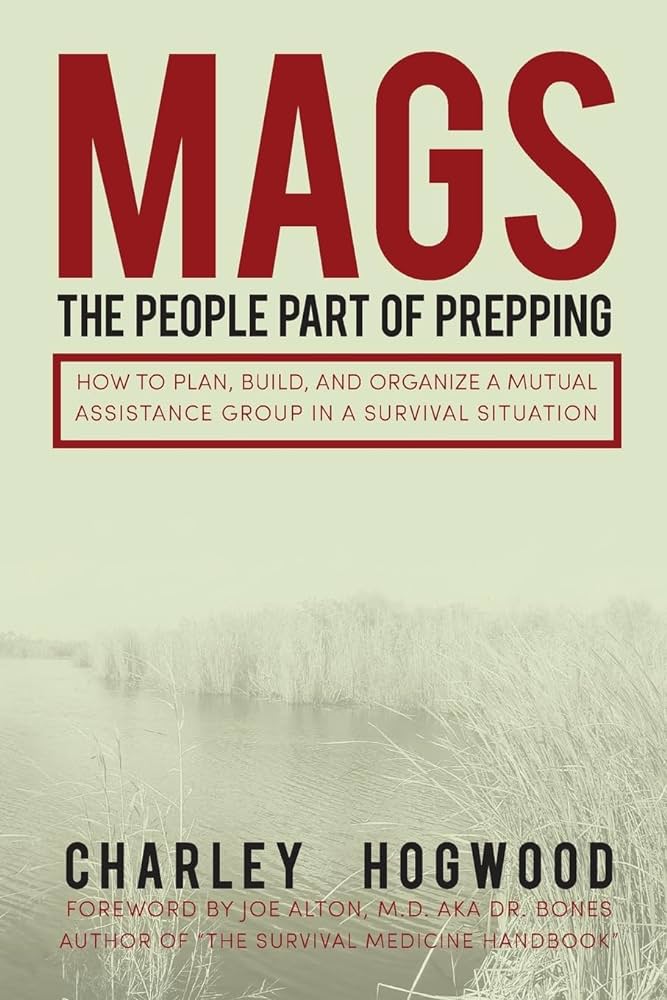
One of the 'bibles' on the subject is the book MAGS: THE PEOPLE PART OF PREPPING – How to Plan, Build and Organize a Mutual Assistance Group In a Survival Situation by Charley Hogwood, featured here as the cover image for our topic and which we strongly recommend reading right away.
Mutual assistance groups emerge as a collective response to growing social, economic and environmental challenges, offering a structure based on solidarity and mutual support. These groups, often formed within communities, have proven essential both in crisis situations and in times of normality, promoting social cohesion and community strengthening.
The G.N.P.A. currently has several local units (MAGs) all across Portugal, as well as district hubs for higher-level organisation.
If you are interested in taking part, join us here.
Foundations, importance and operation of MAGs
1\. What are Mutual Assistance Groups?
Mutual assistance groups are local cells, formally organised by our association, that bring together individuals with the aim of helping one another in various situations, whether through the sharing of resources, information or emotional support. Assistance can take many forms, including:
- Economic support: products, services, or financial help.
- Emotional assistance: psychological and social support in times of crisis.
- Education and training: sharing knowledge and skills.
- Logistical support: help with organising events, transport, or the distribution of supplies.
In essence, these groups promote solidarity, emphasising interdependence and collaboration rather than individualistic competition.
2\. The Importance of Mutual Assistance Groups
The importance of mutual assistance groups is multifaceted, encompassing various social, economic and cultural aspects.
2.1 Strengthening the Community
One of the main benefits of mutual assistance groups is the strengthening of the community's social fabric. By promoting interaction and dynamics between members, these groups help build stronger bonds and a support network that can be essential during periods of crisis. Furthermore, collaboration between individuals creates a sense of belonging that strengthens community identity.
2.2 Resilience in Times of Crisis
In times of crisis, such as natural disasters, economic crises, pandemics or wars, mutual assistance groups become a vital resource. They offer a fast and adaptable response to the emerging needs of the population, often more effective than government efforts or those of large organisations. This agility allows communities to mobilise quickly, setting priorities and helping those most in need.
2.3 Education and Empowerment
Mutual assistance groups often act as platforms for education and empowerment. Through workshops, talks and the exchange of experiences, members can learn valuable skills that improve their quality of life and increase their capacity to face challenges. This ranges from practical skills, such as gardening and cooking, to more complex topics, such as personal finance and sustainable development.
2.4 Promoting Autonomy
By encouraging self-sufficiency and collaborative work, mutual assistance groups promote the autonomy of individuals. Instead of relying exclusively on outside help, members learn to be proactive in meeting their own needs and those of their neighbours. This autonomy is essential for building resilient and sustainable communities.
3\. How Mutual Assistance Groups Operate
Mutual assistance groups can vary widely in their structure, but they generally share some common principles and practices.
3.1 Organisational Structure
In most cases, mutual assistance groups adopt a hybrid structure, with a horizontal stance in which all members have a voice and take part in decision-making, which is then implemented by the command structure, whose chain of hierarchy is defined in advance. This translates into a collaborative environment with everyone's participation in times of peace, and a command that can assume leadership in times of crisis, streamlining operations and taking critical decisions that might otherwise fail to reach consensus and lead to internal conflict.
3.2 Regular Meetings
Regular meetings are a central component of how groups operate. They can be held weekly, monthly, or at any frequency that suits the members' needs. These meetings are opportunities to discuss needs, plan activities, reinforce community bonds and resolve conflicts.
3.3 Sharing of Resources
One of the fundamental principles of mutual assistance groups is mutual aid with a view to collective survival. As such, the provision of supplies, equipment, knowledge or services within the community is done in a way that ensures the survival of those who contribute to it.
3.4 Communication and Transparency
Clear communication and transparency are essential for a mutual assistance group to function well. Using communication platforms such as WhatsApp groups, emails or social networks can facilitate the exchange of information and the ongoing engagement of members. Keeping all participants informed about the group's activities and decisions helps avoid misunderstandings and builds trust.
3.5 Continuous Evaluation
To ensure the group's effectiveness and relevance, it is important to carry out regular evaluations. This can include reflecting on what is working well, which areas need improvement, and how the community's needs may be changing. This process of self-assessment allows the group to adapt and evolve over time.
4\. Challenges and Opportunities
Although mutual assistance groups offer many benefits, they also face challenges. Among these challenges, the following stand out:
- Sustainability: maintaining interest over the long term can be difficult, especially if members are facing their own hardships.
- Conflict Management: the group can be tested in situations of disagreement or by competition over limited resources, which is why it should have a well-defined command structure.
- Recognition: the work carried out by these groups often does not receive the recognition it deserves from society or the authorities.
On the other hand, these challenges also offer opportunities. Facing and overcoming conflict can strengthen the bonds between members and foster problem-solving skills. Moreover, a successful group can inspire other communities to form their own support groups, expanding the network of solidarity.
Conclusion
Mutual assistance groups are a powerful expression of human solidarity and of a community's capacity to face adversity. They not only offer practical support in times of need, but also help build more cohesive and resilient communities. In an increasingly individualistic world marked by inequality, promoting and strengthening these groups can be a decisive path towards a fairer and more supportive future. By investing in mutual assistance, societies can cultivate a spirit of cooperation that transcends crises and becomes a fundamental feature of their everyday interactions.
The G.N.P.A. currently has a formal and hierarchical structure, so if you are interested in these groups, request more information when you join our community.