
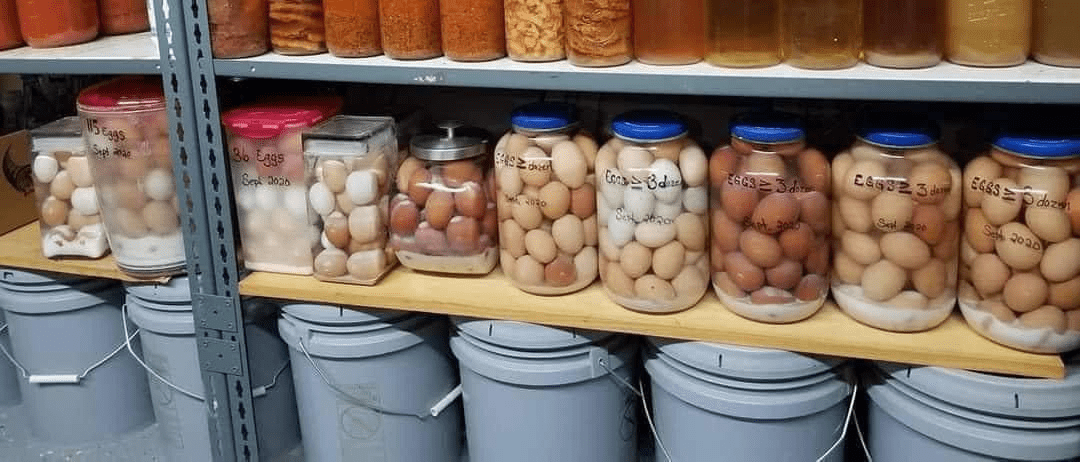
Preserving Eggs
1\. Using hydrogen peroxide.
It is recommended to preserve hen's eggs in a 5% hydrogen peroxide solution. Eggs treated this way are free of unpleasant smell and taste, and are in no way distinguishable from fresh eggs. It was found, however, that once cooked, the egg white was a little more compact than that of
fresh eggs.
2\. Using vegetable oils.
Vegetable oil is applied to the eggs. 1,000 eggs of 55 g each require about 50 g of oil.
3\. Using paraffin.
Eggs that are dipped in a paraffin bath can be preserved for a long time without altering their smell or taste; 1 kg of paraffin is enough for 3,000 eggs.
4\. Using sodium silicate.
With continuous stirring, prepare a mixture of 10 litres of water and one litre of sodium silicate. This quantity of 11 litres of liquid is enough for about 200 eggs. The eggs to be preserved should be placed, in a clean state, in an earthenware container. A hermetic seal is not needed, but a well-fitting lid is. The containers are best kept in a cellar.
5\. Using lime.
Fresh quicklime is slaked, preparing a well-diluted lime milk; this is poured over the eggs placed in a glazed earthenware container. The eggs should first be treated in a slightly red potassium permanganate solution. After this washing they should not be dried with a cloth. The liquid must completely cover all the eggs. Place the eggs in the glazed earthenware or faience vessel and slowly pour the liquid over them until the surface is about 3 to 4 centimetres above the eggs; evaporation is prevented by covering the surface of the liquid with paraffin paper. This method of preservation is very cheap and highly effective.
6. *The application of petroleum jelly, or a mixture of thick linseed oil and wax, to the eggs is also approved
**Solution for testing eggs:
***Only those eggs that sink in a solution of 20 g of cooking salt in 200 g of water are suitable for preservation. Those that keep floating are already too old to preserve.
***Preserving the egg yolk and white.
***To preserve egg yolk in private homes, e.g. for making cake, etc., the yolk is mixed with a generous amount of wheat flour, the finely rolled-out dough is dried and then ground. In this way, both the yolk and the egg white can be preserved for a long time in well-sealed boxes. When the yolk is to be used for special purposes, it is beaten with rum, cognac or French brandy, and packed in bottles, which are kept corked and sealed.